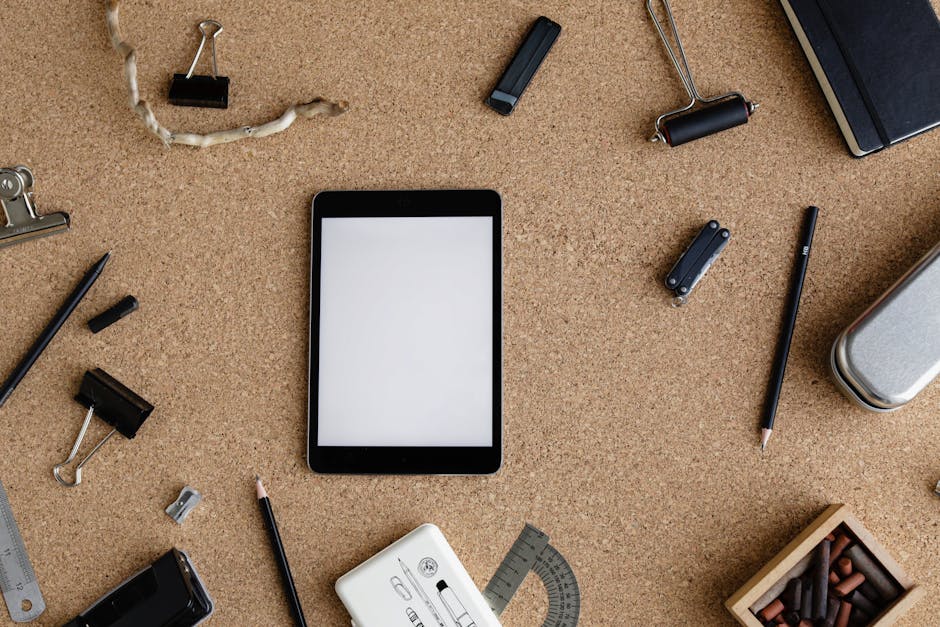
It was a Tuesday in November 2019, and I was sitting in ‘The Daily Grind’ in Seattle—this cramped little coffee shop where the tables are barely wide enough for a latte and a notebook. I had my brand new 11-inch iPad Pro, the one I’d convinced myself would replace my laptop. I reached for my coffee, caught the charging cable with my elbow, and watched $900 of glass and aluminum do a slow-motion somersault onto the concrete floor. The screen didn’t just crack; it shattered into a spiderweb so dense I could barely see the ‘Enter Passcode’ prompt. Apple wanted $499 to fix it. That was the moment the spell broke. I realized I wasn’t paying for a tool; I was paying for a fragile status symbol that I was too scared to actually use.
Since then, I’ve cycled through almost everything. Surface Pros, Samsung Tabs, even those weird e-ink tablets that promise to make you a genius. Most tablet comparisons you read are written by people who get these devices for free and use them for forty-eight hours before writing a ‘comprehensive’ review. I bought these with my own money. I’ve lived with them. And honestly? Most of you are being lied to about what you actually need.
The iPad Pro is a scam for your ego
I’ll just say it. If you are buying an iPad Pro with an M4 chip to check your email and watch Netflix, you are being scammed. Not by Apple, but by your own ego. We buy the ‘Pro’ because we want to believe we’re the kind of person who edits 4K video on a train or designs architectural blueprints at a bar. You aren’t. I’m not. What I mean is—actually, let me put it differently. The iPad Pro is like owning a high-end espresso machine that cost three grand when all you ever drink is instant coffee. It’s overkill in a way that actually makes the experience worse because you’re constantly aware of the wasted potential.
The hardware is staggering. It’s thinner than a pencil. The OLED screen is so bright it’ll sear your retinas. But iPadOS is still just a giant phone operating system. I tried to do a simple spreadsheet comparison last week—standard stuff, two windows side-by-side, moving data between them—and I almost threw the thing out the window. The ‘Stage Manager’ feature is a joke. It’s a solution to a problem Apple created by refusing to just give us a damn cursor that works like a normal human expects. I know people will disagree and tell me I just ‘don’t get the workflow,’ but I’ve tried. For three years. It’s clunky.
The iPad Pro is a $1,200 paperweight that occasionally shows me emails.
Unless you are literally an illustrator who needs the Apple Pencil’s specific latency, or someone who actually—honestly—edits video for a living on the go, stop. Just stop. Buy the Air. Or better yet, buy a refurbished model from two years ago. You won’t notice the difference. I promise.
Samsung actually figured out the ‘Computer’ thing
I used to be an Android hater. I thought the tablets were cheap, plastic garbage with apps that looked like blown-up phone versions. I was completely wrong. I picked up a Galaxy Tab S9 Ultra recently, and while it’s hilariously large—it’s 732 grams, which sounds light until you’re holding it in bed and it hits you in the face—it actually functions like a computer.
Samsung DeX is the only reason to buy a tablet for work. You plug it into a monitor, or even just toggle a button on the screen, and suddenly you have windows. Real, overlapping, resizable windows. I tested this against my old iPad Pro by trying to manage a 50-tab research project for a blog post. On the iPad, I felt like I was breathing through a straw. On the Samsung, I felt like I had a desk.
- The Screen: 14.6 inches of AMOLED. It makes the iPad look dull.
- The Aspect Ratio: 16:10 is better for movies, worse for reading. It feels like a surfboard.
- The Pen: It comes in the box. Imagine that. Not charging $129 for a plastic stick.
But here is my unfair take: I hate the way the S-Pen feels. It’s too soft. It feels like writing with a felt-tip marker on a marshmallow. I know some people love that ‘friction,’ but it makes my skin crawl. I want the hard plastic-on-glass tap of the Apple Pencil. It’s a stupid, irrational reason to prefer one device over the other, but I’m the one typing on it for four hours a day. If the tactile feedback is wrong, the whole device is wrong.
Samsung wins on utility. Apple wins on ‘feel.’ Pick your poison.
The part nobody talks about
We need to talk about the iPad Mini. I despise it. I see these tech influencers talking about how it’s the ‘perfect portable companion,’ and I feel like I’m taking crazy pills. It’s too small to do real work and too big to fit in a pocket. It’s the cargo shorts of the tech world. If you have hands larger than a ten-year-old’s, typing on it is a nightmare of typos and regret. I bought one for a trip to Japan in 2022 thinking it would be my ultimate travel device. I ended up using my iPhone 14 Pro for everything because the screen wasn’t significantly enough of an upgrade to warrant carrying a second device.
Anyway, I ended up giving it to my nephew. He loves it for Roblox. That is the only valid use case for an iPad Mini: children and people who really, really like tiny notebooks. For everyone else, it’s a compromise that serves nobody.
Actually, let me go on a quick tangent about e-ink. I spent $400 on a ReMarkable 2 because I thought it would turn me into a focused writing machine. It didn’t. It’s a beautiful piece of hardware that does one thing: it lets you write on a screen that looks like paper. But you can’t search your notes easily, the sync is finicky, and the lack of a backlight means you can’t use it in a dimly lit room without feeling like you’re in the 1800s reading by candlelight. It’s a distraction-free device that is, itself, a distraction because you’re always fiddling with the ‘perfect’ pen setting. But I digress.
A quick verdict for people who just want an answer
I’ve spent way too much time thinking about this, so here is the blunt truth. Most people fall into three categories. Don’t overthink it.
If you just want a tablet to be a tablet—meaning you want to watch YouTube, read the news, and maybe play a game—buy the base model iPad. Not the Air, not the Pro. The cheap one. It’s $349 or less on sale. It does 95% of what the $1,000 one does for a third of the price.
If you genuinely want to try and work on a tablet, buy the Samsung Tab S9+ (the middle size). The multitasking is actually usable, and the file system doesn’t treat you like a child.
If you are a professional artist, buy the iPad Pro and just accept that you’re paying the ‘Apple Tax’ for the best stylus experience on the market.
Everything else is just marketing noise.
The real question I keep coming back to is why we’re so obsessed with these things in the first place. I’m writing this on a MacBook Air because, despite owning three different tablets right now, none of them are as good as a laptop with a real keyboard. We keep trying to force tablets to be something they aren’t because the commercials make it look so effortless. They show a woman in a sun-drenched loft effortlessly sketching a masterpiece, and we think, ‘If I buy that, I’ll be that person.’
But you’ll just be you, sitting in a messy living room, trying to figure out why the copy-paste function isn’t working for the fourth time today.
Is the dream of the ‘one device’ actually dead?
